Spanish nouns (I)
As well as for members of the family and names of jobs, all nouns in Spanish are classed as either masculine or feminine.
Masculine nouns normally end in –o and feminine nouns normally end in –a:
el niño (the boy)
la niña (the girl)
“el” and “la” both mean “the”. This is known as the definite article. Continue reading
Receta para patatas bravas (Recipe for “spicy potato wedges”)
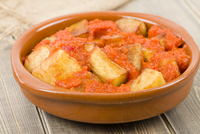 “Patatas bravas” is a classical Spanish tapas dish, known in English as “spicy potato wedges”. They are typically served in a spicy tomato sauce or with mayonnaise. The dish is often ordered with a variety of toppings including chorizo, chicken and fried fish. The same spicy sauce is also used as a topping for mejillones (mussels) called “mejillones en salsa brava”. Here is the recipe in Spanish and English: Continue reading
How can I help my child learn a foreign language?
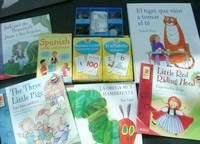 Maybe you are planning a holiday in a foreign country or perhaps you have family or friends living abroad and want to learn the language to communicate easily. You may think that because you aren’t fluent in a language you won’t be able to teach your child, however, it isn’t difficult to learn a few of the basics as you go along. Besides, learning about another language and culture together is an excellent way to spend quality time as a family.
Read on for tips on helping your and your child learn another language. Find links to the best language learning resources available today.
Continue reading
Interview with British expat living in Ronda, Spain.
 The following interview with British expat Frank Hughes, who has recently relocated to Spain, gives a real insight in to what it is really like to live there. It is a worthwhile read for anyone who is planning to move to Spain.
Where are you from originally and where in Spain do you live?
I am from Birmingham and live in Peterborough and in Spain in Ronda, Andalucia.
When to use “mal” or “malo” in Spanish
“Malo” is the adjective (describing word) which normally means “bad” but can also mean “ill”, “poor”, “wrong”. It also has a feminine form, “mala” as well as plural forms, “malos” and “malas”.
Look at these examples:
Empecé a leer un libro tan malo que no podía terminarlo.
I started to read such a bad book that I couldn’t finish it.
¡Mala suerte!: Bad luck! [suerte is a feminine noun] Continue reading
Receta para “Tortilla de patata”(Tortilla española) [Spanish & English]
 Tortilla de patata (Spanish potato omelette) is a classic Spanish dish served either hot or cold for breakfast, as a main course or in Spain, as a tapas bar snack, cut into small pieces or wedged between chunks of fresh bread as a filling in a “bocadillo”. It is delicious, very filling and perhaps a little fattening! Here is a simple recipe to make this tasty, traditional Spanish dish. Continue reading
“Torrijas” (Sweet bread pudding) – Traditional Spanish Easter sweet [Receta/Recipe]
 This traditional sweet is eaten in Spain during Lent (La Cuaresma), the 40 days leading up to Easter. In English we would call “torrijas” “bread pudding” and America they would call them “French toast”. Although they are normally eaten for breakfast, they can be eaten at any time of the day. They are also sometimes known as “rebandas de Carnaval” or “tortillas de leche”. There are several variations but the most typical consist of bread, milk, honey and sugar. Here is a quick and easy recipe for you to try them at home: Continue reading
Interesting interview: an insight into working with the Guatemalan Fire/Rescue Service (Bomberos)

Guatemalan Volunteer Bomberos
People learn Spanish for a wide variety of reasons; they have property in Spain, for holidays/emigrating or they work with Spanish companies. However, I recently helped a local paramedic, Cameron Wyatt, who had a different reason for learning Spanish – he was preparing for a trip to Guatemala City to work with the Guatemalan Fire Service. I recently interviewed Cameron to find out what to expect from a visit to Guatemala and how to prepare for such a trip. It sounds like a real eye opener! Continue reading
Useful everyday expressions using “Tener”
“Tener” (to have) is perhaps one of the most useful verbs to know in Spanish because apart from being used to express possession, it has many other everyday uses. In this post we will look at some of the most common idiomatic expressions using “tener”. (Idiomatic expressions are just phrases that cannot be understood by translating literally.) Continue reading
How do you say “it” in Spanish?
Although we have just one way of saying “it” in English, in Spanish there are various ways of saying “it” and sometimes there is no specific word used at all. In this article we will look at the different ways to express “it” in Spanish depending on the type of sentence and whether “it” is the subject, a direct object of the verb or of a preposition. Continue reading
Follow Us


