Why you must visit the Alhambra palace, Granada.
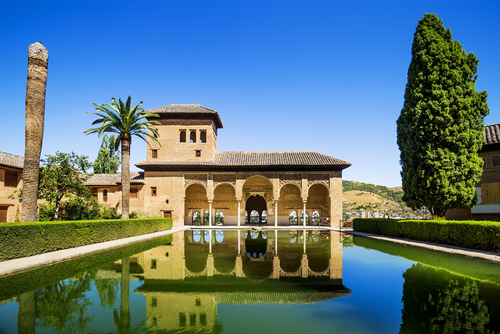 With over two million visitors a year it is easy to see why the Alhambra, known as the “Jewel of Moorish Spain” is well worth a visit. Here are a few good reasons why:
Beautiful location:
The Alhambra is an ancient palace-fortress built by the Arabs in the middle of the fourteenth century which sits on a hilltop overlooking the Andalucian city of Granada with the Sierra Nevada mountains in the background. You can see the beautiful Alhambra palace from miles around.
Continue reading
Huevos Rotos con Chorizo / Broken Eggs with Spicy Sausage
This is a quick and easy traditional Spanish recipe, similar to scrambled eggs in English. Practice your listening skills by listening to this Youtube video and read the script in Spanish with the English translation.
Hoy vamos a preparar huevos rotos con chorizo.
Today we are going to make broken eggs with spicy Spanish sausage.
Qué v. Cuál
“Qué” and “Cuál” cause quite a few problems for learners of Spanish because they can both be translated as “Which” and “What” in different contexts. Generally “qué” means “what” and “cuál” means “which” however this can vary. In this blog post we will look at situations when you should use each one to avoid confusion and hopefully make things a bit clearer!
Reading exam tips for AS and A2 language students
Read through the questions before reading the text as they may give you a clue as to what the text is about and key vocabulary to watch out for.
Make sure you know whether you need to answer the questions in Spanish or English.
Read the whole text to understand its general meaning before you start to answer the questions.
Underline the key words in the text as you read through it.
A-level listening exam tips
 Language listening exams can be the most nerve-racking of all for many students. Here are a few tips to help you tackle the listening exam and how to achieve the best mark possible.
Receta para “Pimientos de Padrón” (Typical green Galician peppers recipe)
Hiring a private tutor – a wise investment of time and money!
 An increasing number of parents with children in both state and private schools are “topping-up” their child’s education with private tuition. There are two main reasons why people hire a private tutor for their child; it may be that their child is struggling with a particular subject in school or is underperforming. On the other hand the student may already excel in a subject but needs to fine-tune their revision or exam technique to ensure that they obtain their first choice of university. Here are our top 5 benefits from hiring a private tutor:
Cómo preparar “Mona de Pascua” (How to prepare a traditional Spanish Easter cake)
A traditional Easter sweet pastry typical of Valencia and Catalonia in Spain is the “Mona de Pascua”. The egg in the middle of the cake symbolizes the resurrection of Christ. The “Mona de Pascua” was given out on Easter Sunday but not normally eaten until Easter Monday. These days it is common for this cake to be eaten throughout “Semana Santa” (Holy Week). The cake has become much more elaborate and nowadays is decorated with jellied sweets or chocolate bunnies or even with non-edible features such as feathers and streamers. Watch the video below and listen to the recipe and preparation method in Spanish. The script appears below which has been translated into English:
Las Fallas festival, Valencia (1st – 19th March)
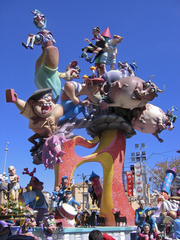 Valencia’s biggest festival, “Las Fallas” is celebrated every March and dates back to the middle ages. It is a pagan ritual to commemorate the patron Saint Joseph. It is also thought to represent the end of winter and welcome the spring through spectacular pyrotechnical displays, explosions and parades. If you go to this riotous Spanish fiesta, don’t expect to sleep much as there is 24-hour partying and explosions going off throughout the night. Read on to find out what to expect from one of Spain’s most spectacular Spanish festivals. Continue reading
Popular Spanish sport: “Pádel” (Padel tennis)
 Pádel is a Spanish racket sport which is becoming more and more popular across Spain and other European countries such as Belgium, Austria, France and Italy. It is similar to tennis with a smaller court but the same line markings. Surrounding the court are high walls of glass or solid material. Scoring is similar to tennis and you can play singles or doubles matches.
The racket is more like a large table tennis bat without strings and you serve underhand rather than overhand.
When it was first played in Spain in the 1970s it was mainly played by the upper classes. However, these days it is played by anyone and everyone of any age, making it a game that the whole family can enjoy together. It is thought to be more intense and fun than tennis and perhaps a little easier to play.
Nowadays all the main towns and cities in Spain have “pistas de pádel” (padel courts) with inter-club tournaments and national circuits. The “Federación Internacional de Pádel” was officially formed in 1991 and by 1993 the game was recognised as an official sports category. Continue reading
Follow Us


