Useful Linking Words and Phrases in Spanish
Just by adding in a few linking words and phrases when you are speaking in Spanish makes you sound much more native-like and it also gives you time to think! You hear these kinds of words and expressions all the time in Spain so it is worth remembering them: Continue reading
Question words in Spanish
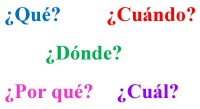 People often confuse the question words in Spanish, so here is a quick reminder of the most important ones to remember. Don’t forget that in Spanish they also include an upside down question mark at the beginning of the question – ¿ – and all question words have an accent.
The differences between Argentinian Spanish and Castilian Spanish
 When I went to Buenos Aires, Argentina I noticed that there were quite a few differences between Castilian Spanish spoken in Spain and the Spanish spoken in Argentina. This involved the accent and pronunciation as well as the grammar and certain words and phrases. The different accent took a bit of getting used to. Although the “porteños” understood my “Spanish” accent (from Spain), the difficulty arose in my understanding of them. Read on to discover the differences to watch out for. Continue reading
Popular Spanish Sayings (II)
In collaboration with a native Spanish person, we have come up with some common sayings (refranes) that are used today in Spain:
Estar entre la espada y la pared. (Lit. To be between the spade and the wall.) Between the devil and the deep blue sea.
Se venden como pan bendito. (Lit. They are sold like holy bread.) They are selling like hot cakes.
Sentar como un guante. To fit like a glove. Continue reading
Interesting Spanish: Compound Words (2 words in 1)
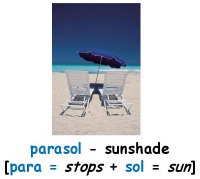 Compound words, “palabras compuestas” are two separate words joined together to create a single word.
For example: parasol (sunshade) is formed from: para (it stops) + sol (sun) [it stops sun]
Often they are created for humour and many do not survive over time.
Here is a list of the most interesting and commonly used in Spanish today: Continue reading
Enjoy learning Spanish by listening to songs!
Listen to “Escapar” (Escape) by Enrique Iglesias
A popular and fun way to improve your Spanish can be achieved effortlessly through listening to songs in Spanish.
To get the most out of this activity, read the lyrics whilst listening to the song.
httpv://youtu.be/_e6lDZTnwwE
Aunque corras, no puedes escapar / Although you run, you can’t escape
Ves, tú y yo / See, you and I
es así / it’s like that
sube y baja / up and down
pero un día al fin / but one day in the end
sin querer / accidentally
nos va bien / we’ll be ok
cuando uno ha dicho se acabó / when one says it’s over
una voz / a voice
dice no / says no
y se queda. / and it remains.
[Estribillo:] / [Chorus:]
Si decides dejarme / If you decide to leave me
no te voy a suplicar / I’m not going to beg you
allá tú si más tarde / you will see later
aunque corras, te escondas / although you run, you hide
no puedes escapar / you can’t escape
aunque corras, te escondas, no puedes escapar. / although you run, you hide, you can’t escape.
Hoy si te vas / Today if you leave
ya verás / you’ll see
que no es tan fácil olvidar / it’s not so easy to forget
sale bien / it goes well
sale mal / it goes bad
como sea, pero es tan real / however, but it is so real
que al final / that in the end
lo demás / the rest
no te importa / doesn’t matter
[Estribillo:] / [Chorus:]
Correrás, / You’ll run,
te esconderás, / you’ll hide
pero no te escaparás. (x2) / but you won’t escape. (x2)
Hoy una voz / Today a voice
dice no / says no
y se queda. / and it stays the same.
Corre y dime adiós. / Run and say to me goodbye.
[Estribillo:] (x2) / [Chorus:] (x2)
You can run, You can run, You can run …..
You can run, You can run, You can run …..
Correrás, nunca vas a escapar, / You’ll run, you’ll never escape,
Correrás, correrás, nunca vas a escapar.
You’ll run, you’ll run, you’re never going to escape.
You can run, You can run.
You can run, You can run.
Aunque corras, no puedes escapar.
Although you run, you can’t escape.
To enquire about other enjoyable ways to learn Spanish or any language, you are more than welcome to contact VLS for complimentary advice or book a few lessons so that you can soon understand the lyrics of any song that you hear!
Watch out for “False Friends” in Spanish!
 In Spanish there are many false cognates – words that look the same as an English word but they have a completely different meaning. This can be confusing and may lead to misunderstanding. Here are the most commonly used “false friends” to watch out for.
1. actual in Spanish means current/present. (To say “actual” in Spanish, use real / verdadero)
2. asistir = to attend NOT to assist (ayudar)
3. atender = to take care of/attend to NOT to attend (asistir)
4. bizarro = brave NOT bizarre/strange (raro / extraño) Continue reading
Popular Spanish Sayings (refranes)
After collaborating with Spanish friends, we have come up with a list of the top sayings (refranes) used every day in Spain today.
1. Cuando las ranas críen pelos. (Lit. When frogs grow hair.)
English equivalent: When pigs might fly. / When hell freezes over.
2. A quien madruga, Dios le ayuda. (Lit. God helps the one who rises early.)
English equivalent: The early bird catches the worm.
3. No hay que empezar la casa por el tejado. (Lit. You mustn’t start the house before the roof.)
English equivalent: Don’t put the cart before the horse. Continue reading
Follow Us


